Title here
Summary here
October 25, 20265 minutes
From October 22 to 25, 2026, the Sovereign Cloud Days brought decision-makers, operators, and the open source community together in Saarbrücken under one motto: Digital Sovereignty. Open. Practical. Now. The weekend belonged to the community-organized OpenInfra & Cloud Native Track on the campus of htw saar, run in cooperation with the OpenInfra Foundation and the CNCF. No vendor pitches, just real experiences from production operations.
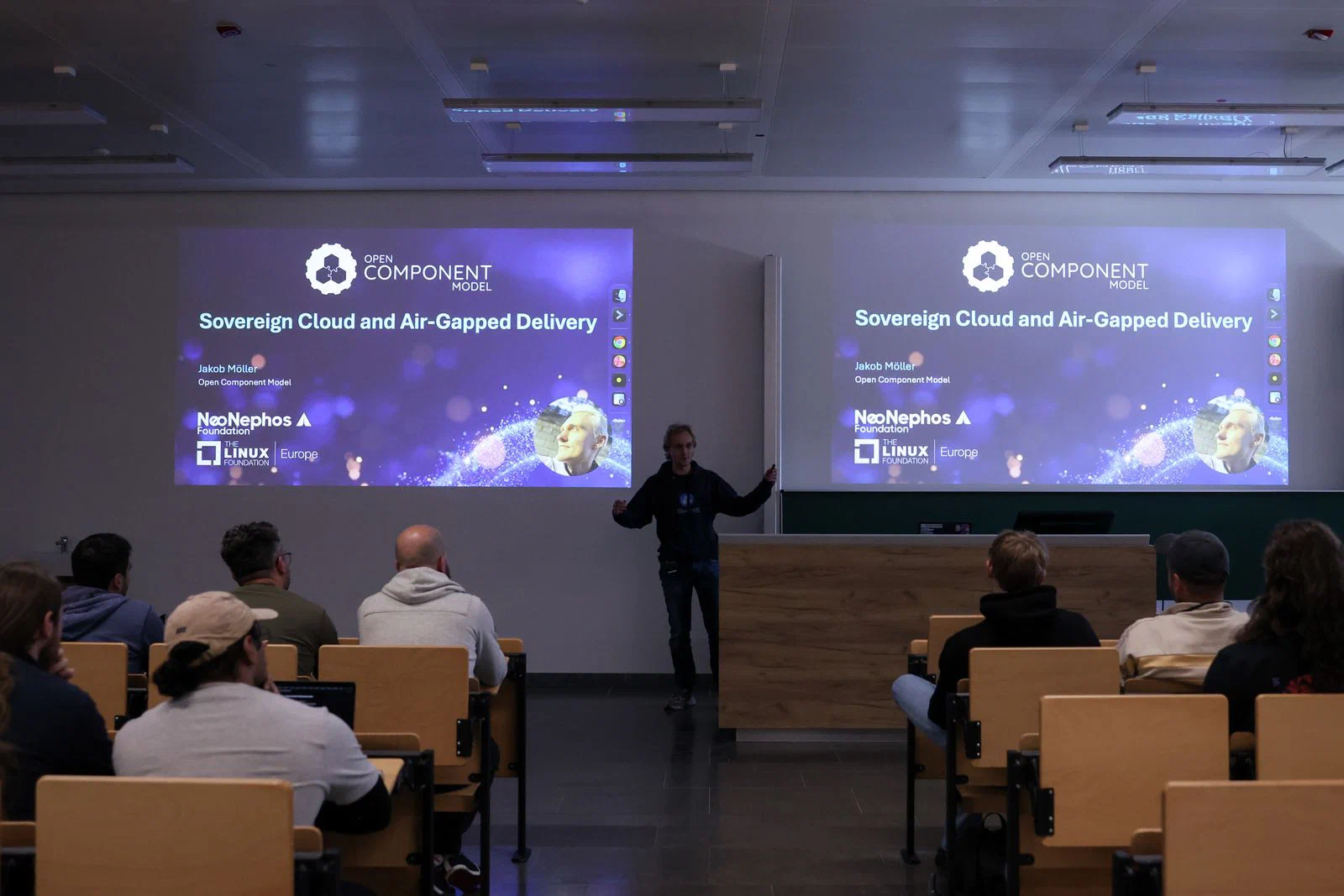
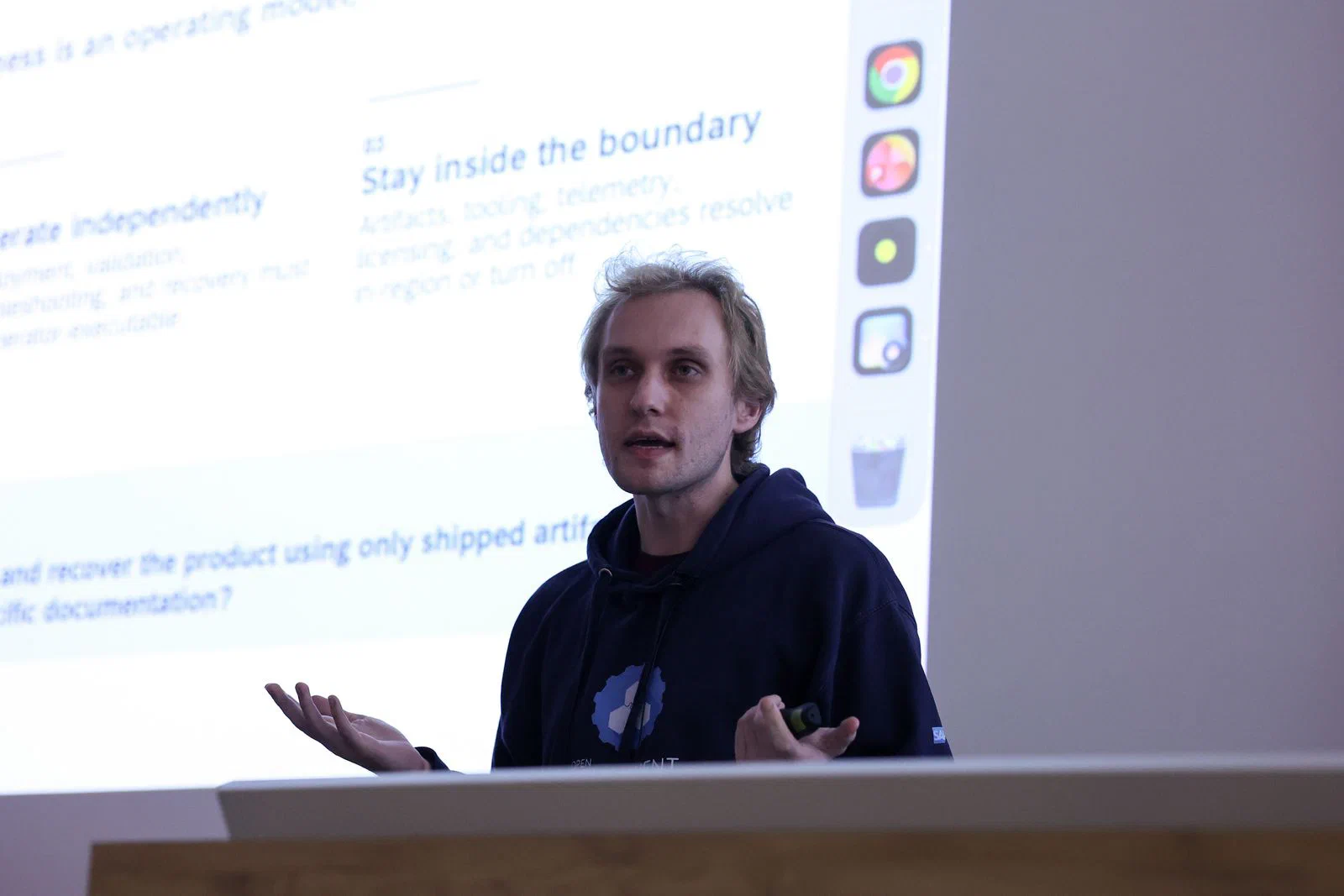
On Sunday, October 25, Jakob Möller took the Main Stage to present Sovereign Cloud and Air-Gapped Delivery with Open Component Model. The question behind the talk is simple: what does it take to deliver software into an environment you are not allowed to call home from?
Page through the full slide deck here, or read on for the highlights:
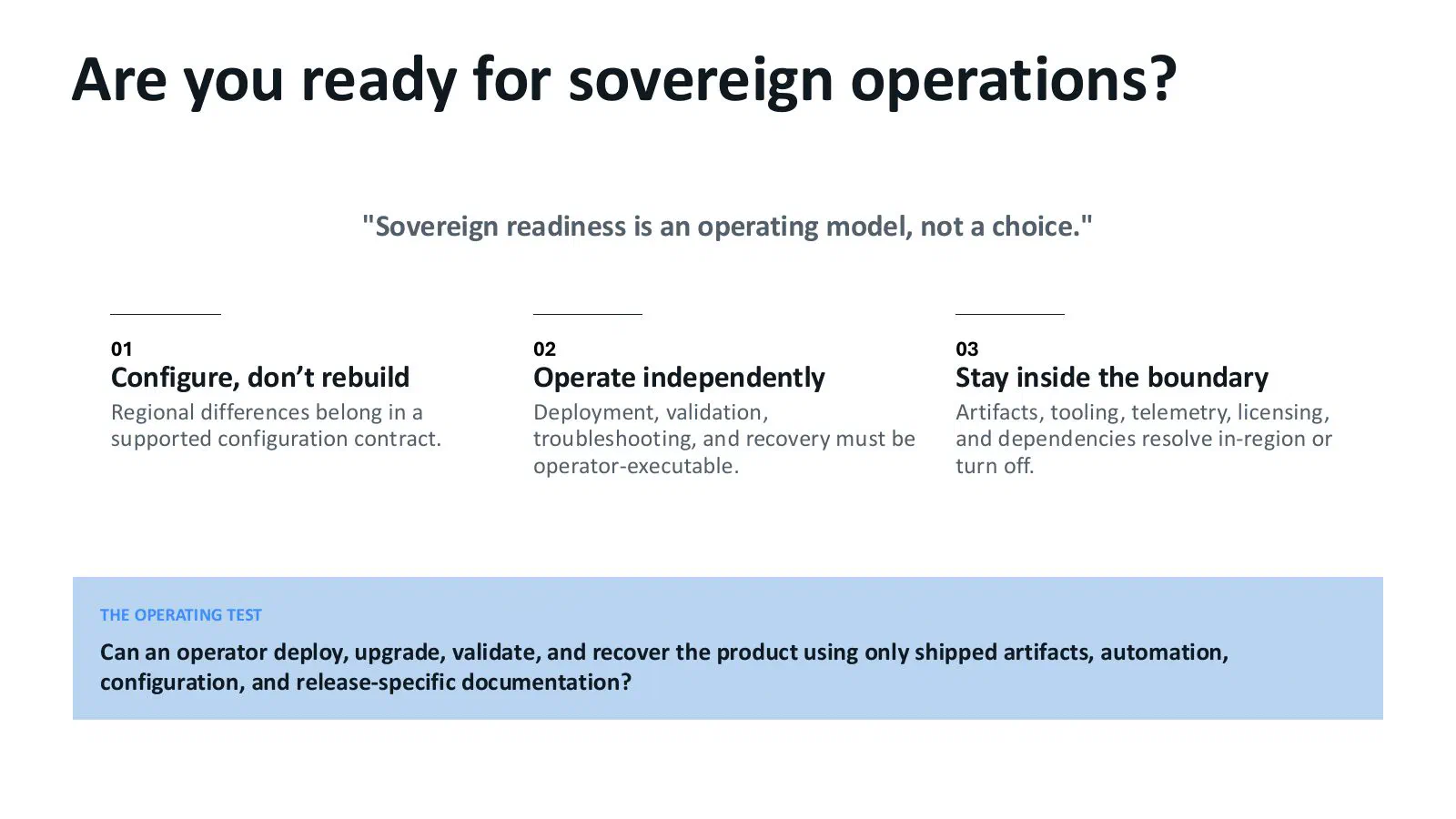
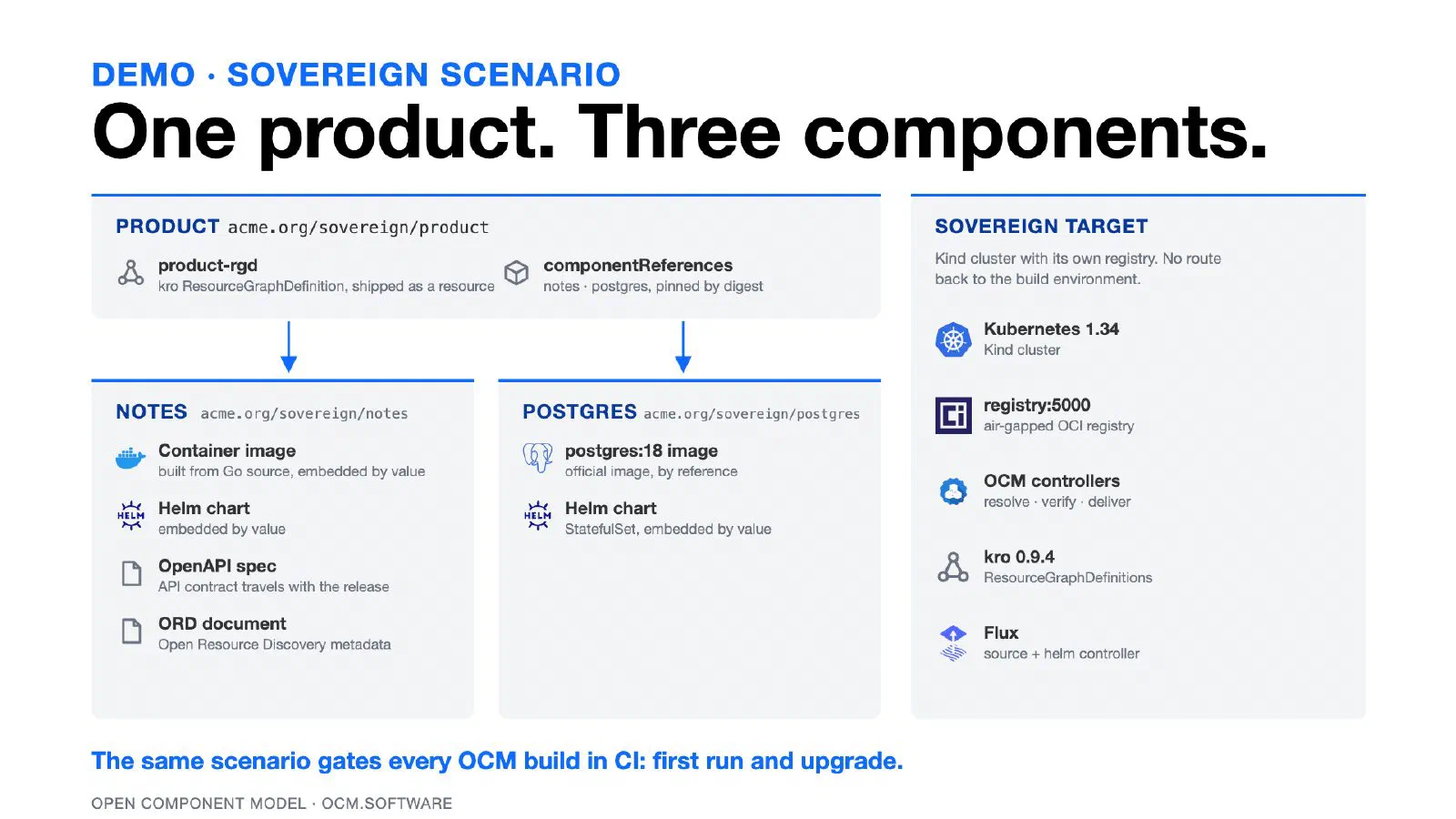
Sovereign cloud is not a deployment target you add at the end of a release. It changes how a product must be built and shipped. The talk framed sovereign readiness around three principles:
These principles boil down to one operating test:
Can an operator deploy, upgrade, validate, and recover the product using only shipped artifacts, automation, configuration, and release-specific documentation?
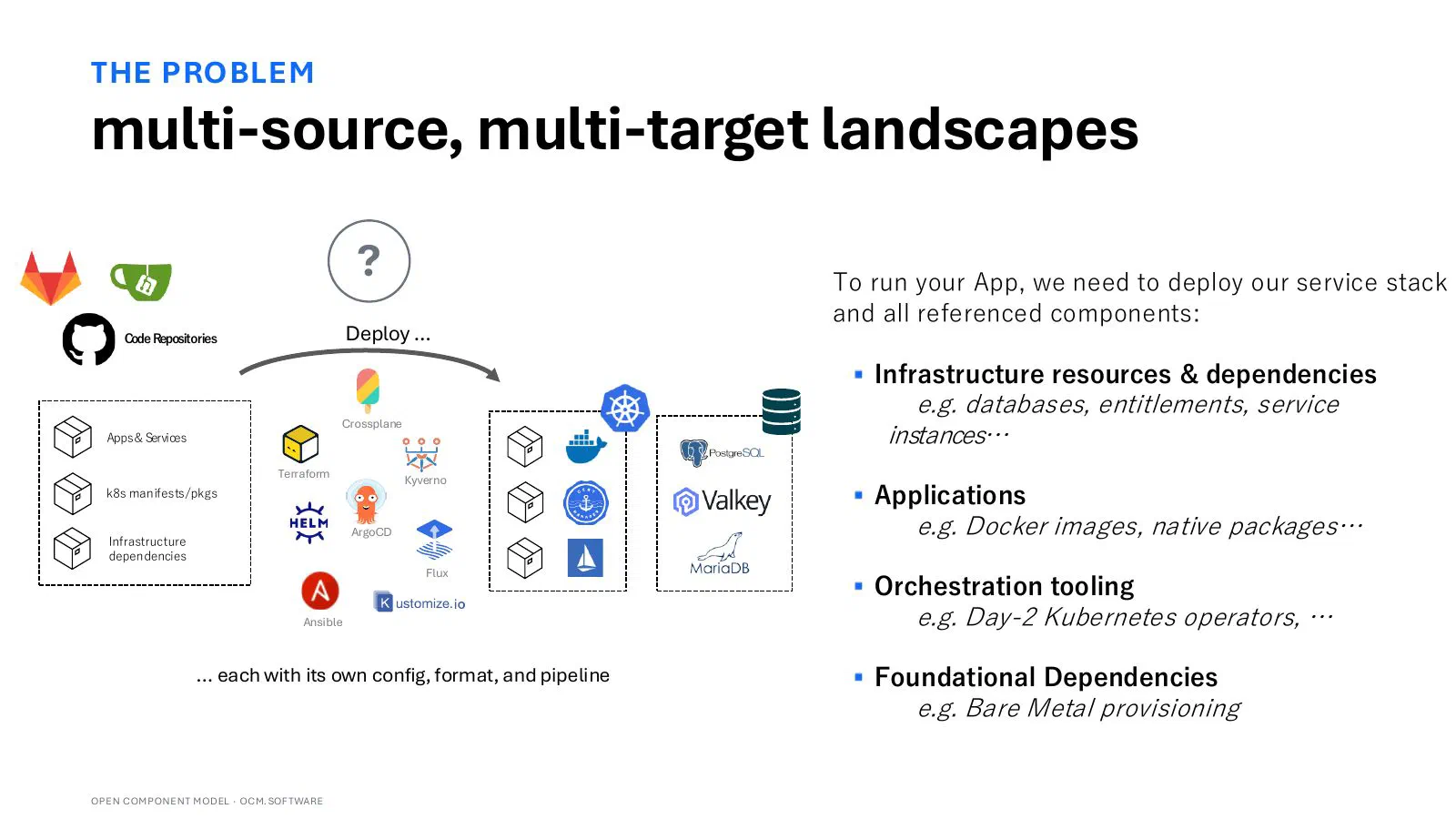
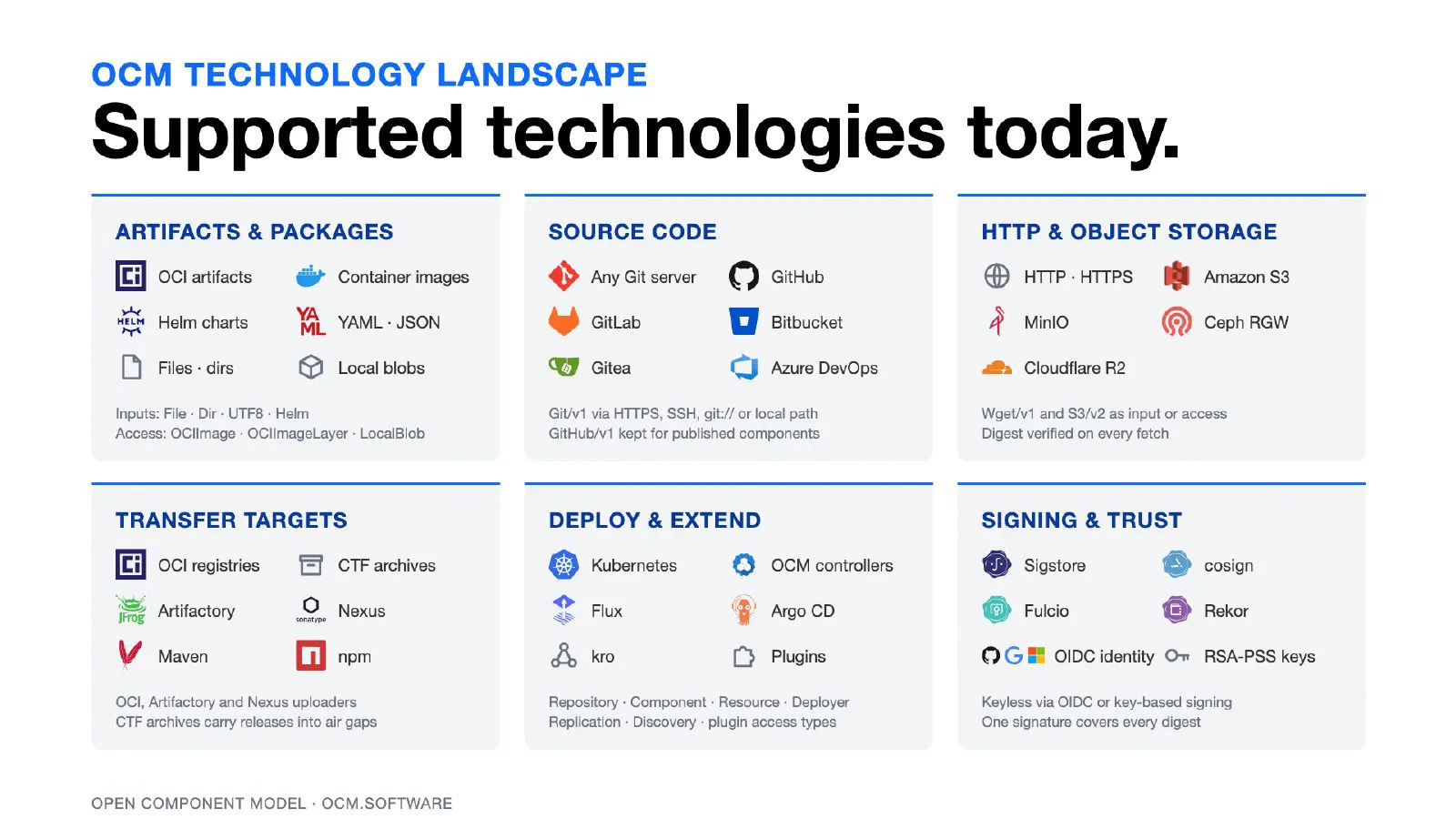
The hard part is that real products are rarely a single artifact. Running one application means delivering the service stack and everything it references: container images, Helm charts, Kubernetes manifests, infrastructure dependencies such as databases, Day-2 operators, and foundational pieces down to bare-metal provisioning. Each comes from its own source, in its own format, through its own pipeline, deployed by Terraform, Crossplane, Argo CD, Flux, Ansible, and friends. Moving that landscape into a sovereign or air-gapped region by hand does not scale, and it does not survive an audit.
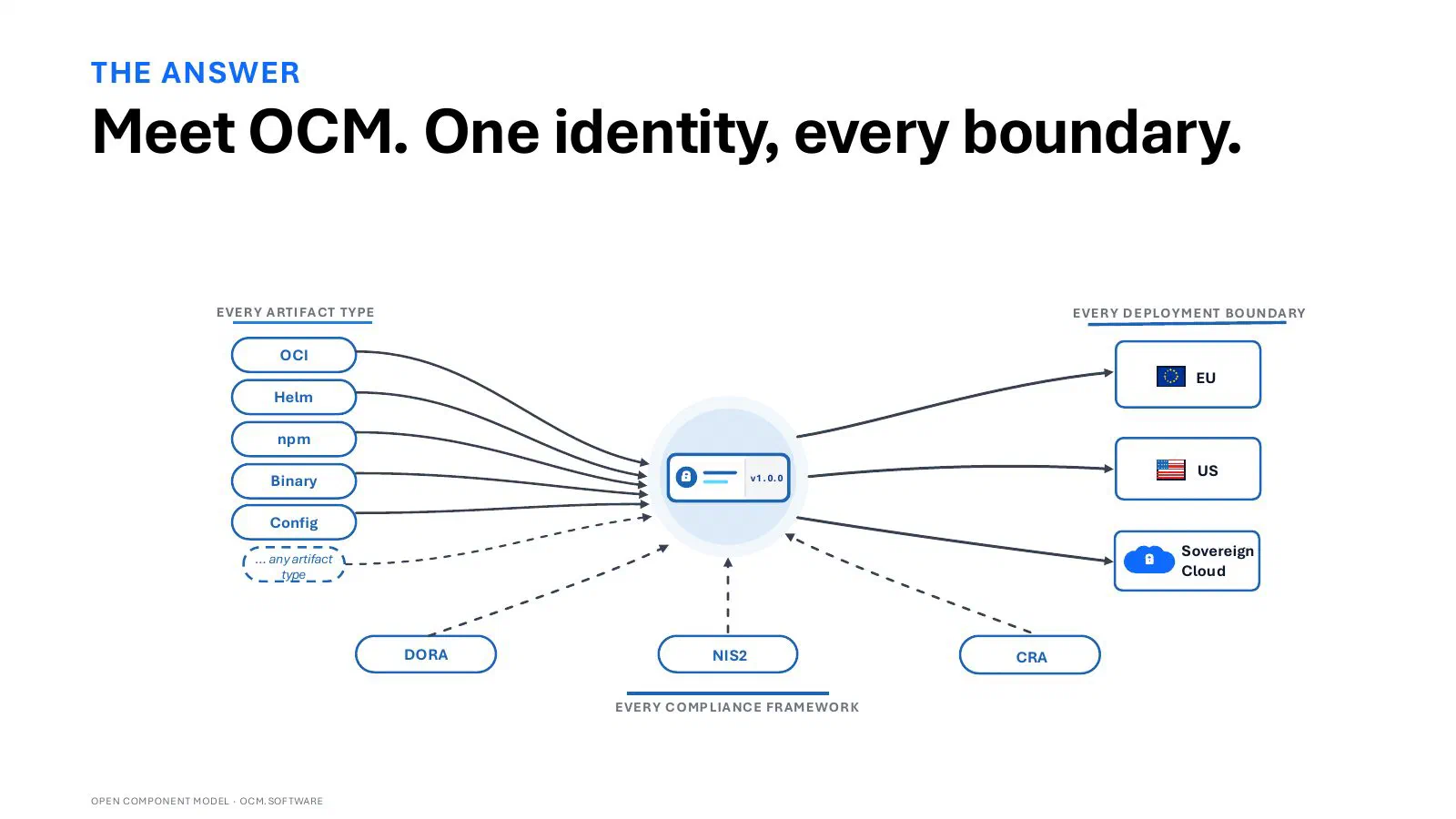
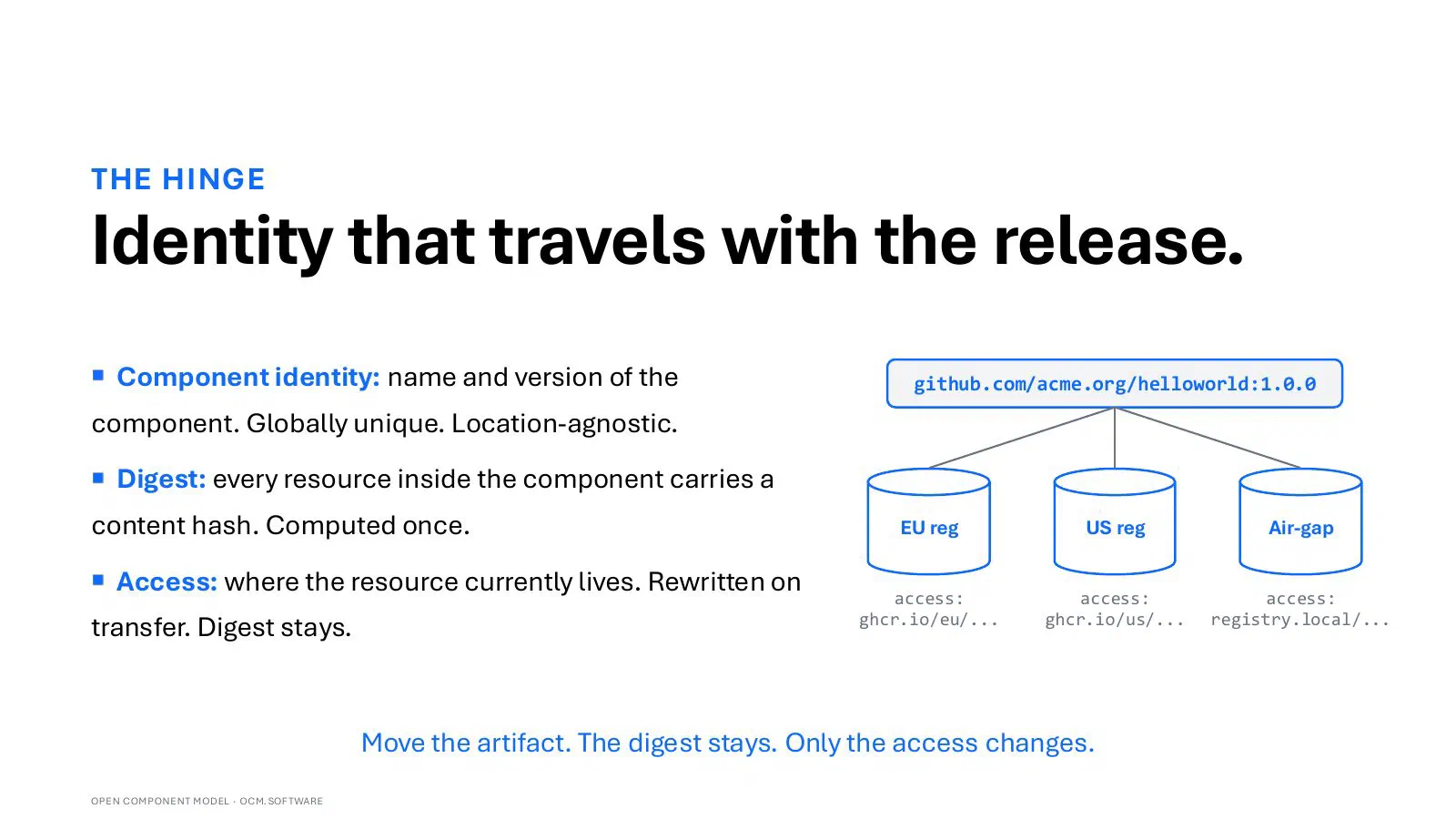
This is the problem OCM was built for. OCM describes every artifact type (OCI images, Helm charts, npm packages, binaries, configuration, or anything else) under one component identity, and lets you move it across every deployment boundary: EU, US, sovereign cloud, or fully disconnected environments. The same evidence then serves compliance frameworks such as DORA, NIS2, and the Cyber Resilience Act.
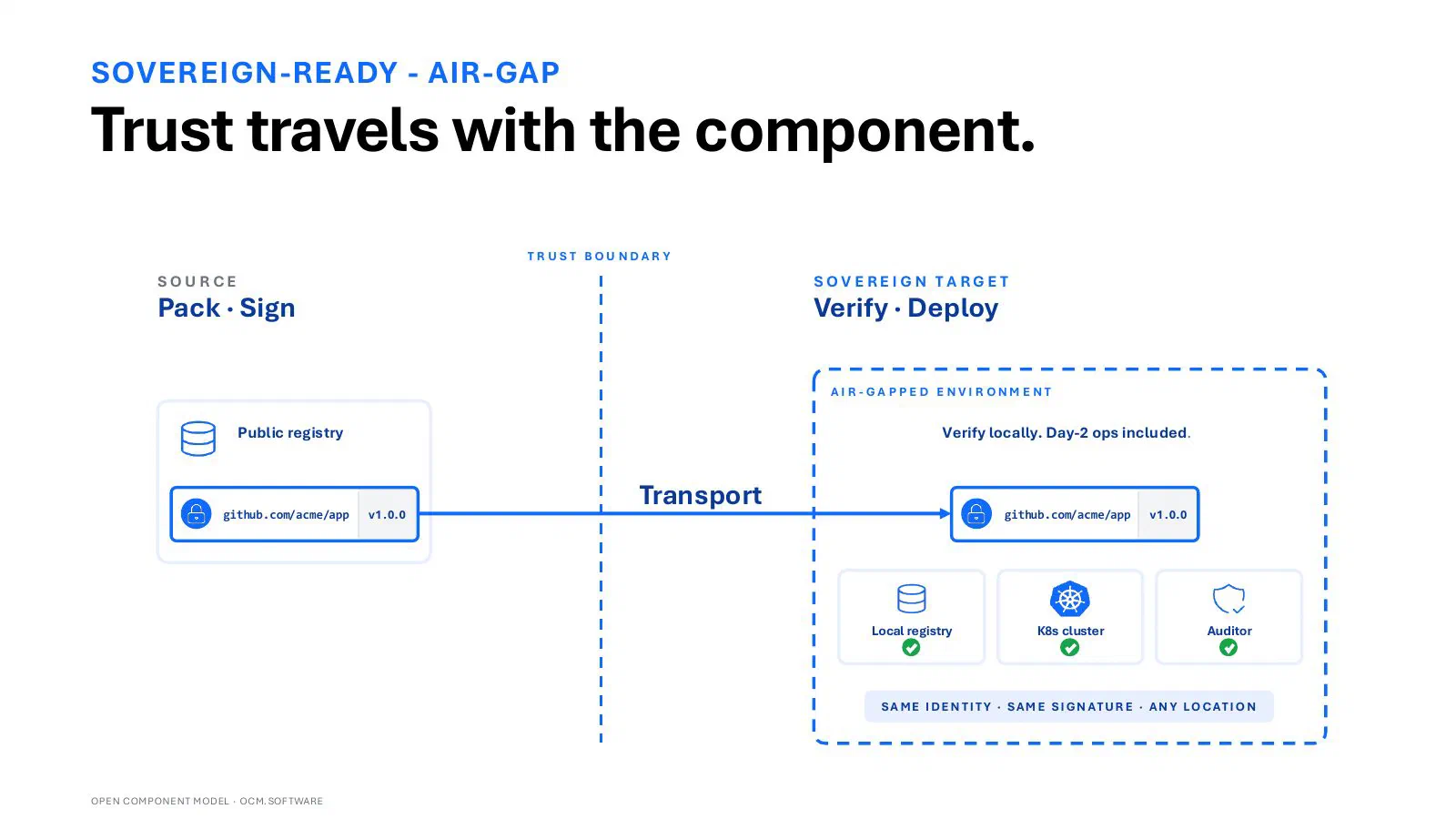
The key idea is that identity and trust travel with the release:
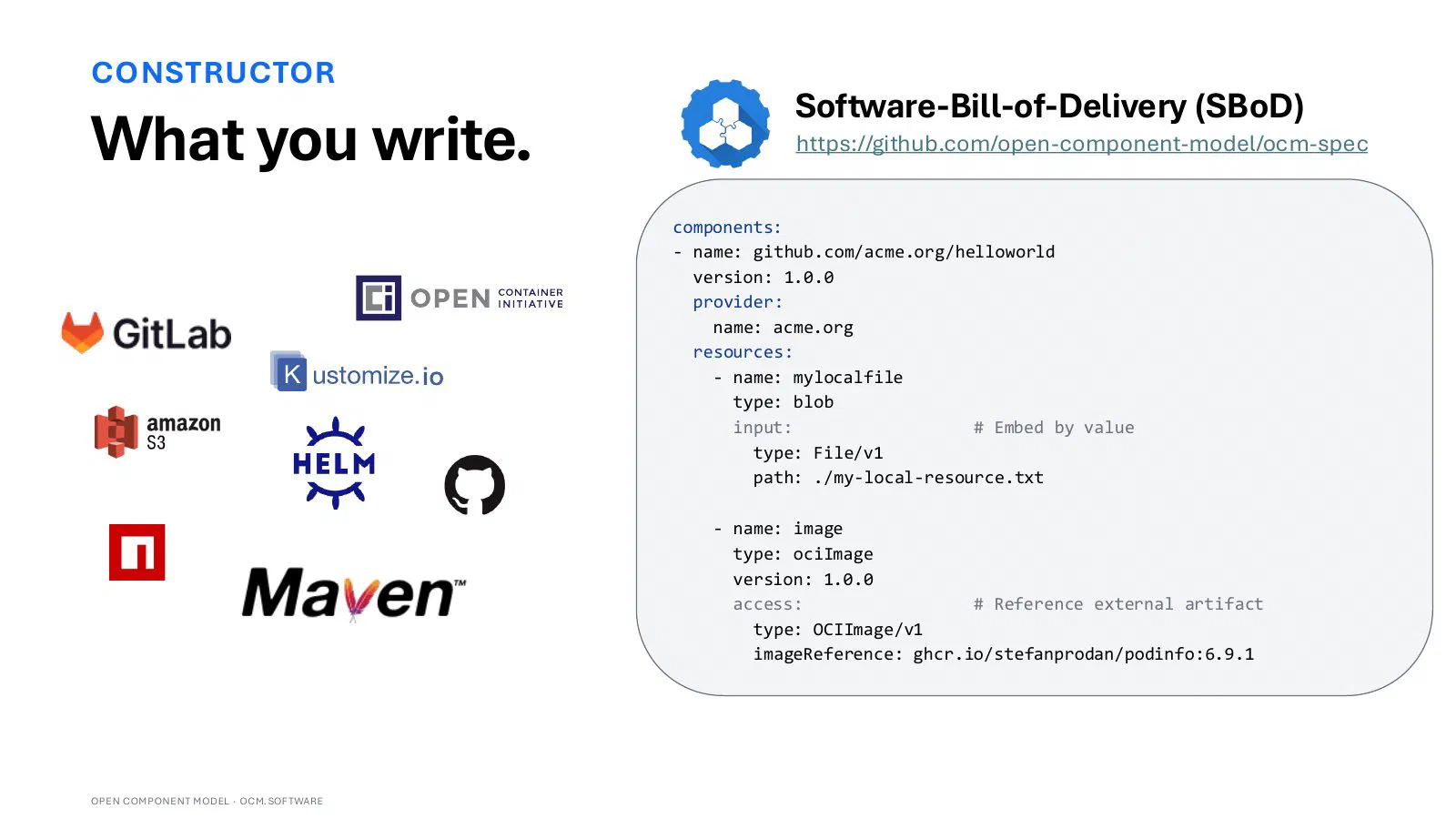
github.com/acme.org/helloworld:1.0.0.A component version starts from a constructor file you write:
components:
  - name: github.com/acme.org/helloworld
    version: 1.0.0
    provider:
      name: acme.org
    resources:
      - name: mylocalfile
        type: blob
        input: # embed by value
          type: File/v1
          path: ./my-local-resource.txt
      - name: image
        type: ociImage
        version: 1.0.0
        access: # reference an external artifact
          type: OCIImage/v1
          imageReference: ghcr.io/stefanprodan/podinfo:6.9.1
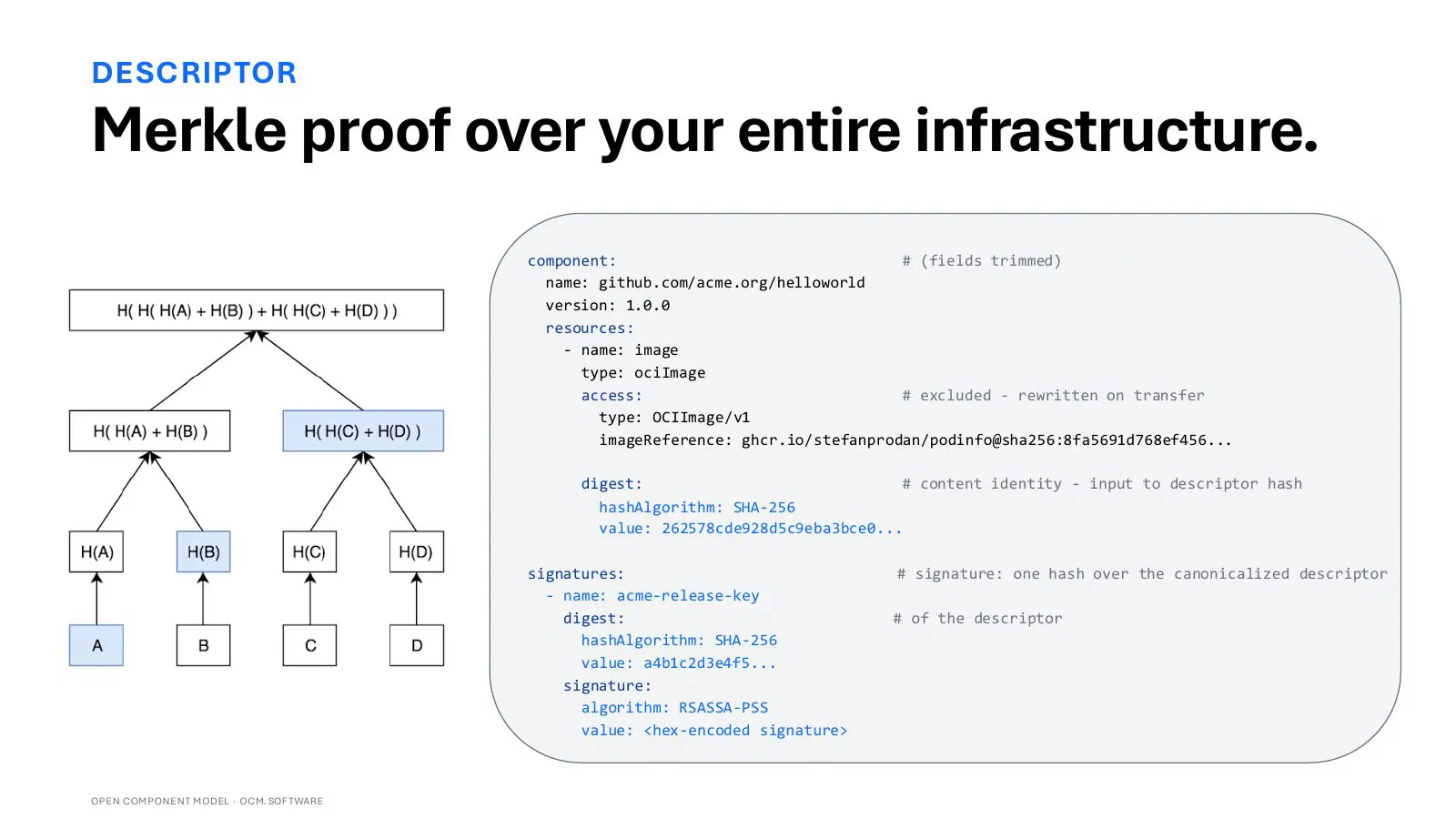
The resulting component descriptor carries the digests of all resources. A signature covers one hash over the normalized
descriptor, which makes it a Merkle proof over everything you ship. Because the access information is excluded from the
signed digest, you can relocate the component from a public registry to registry.local inside an air gap and still verify
the exact same signature there. Read more in Transfer and Transport
and Signing and Verification.
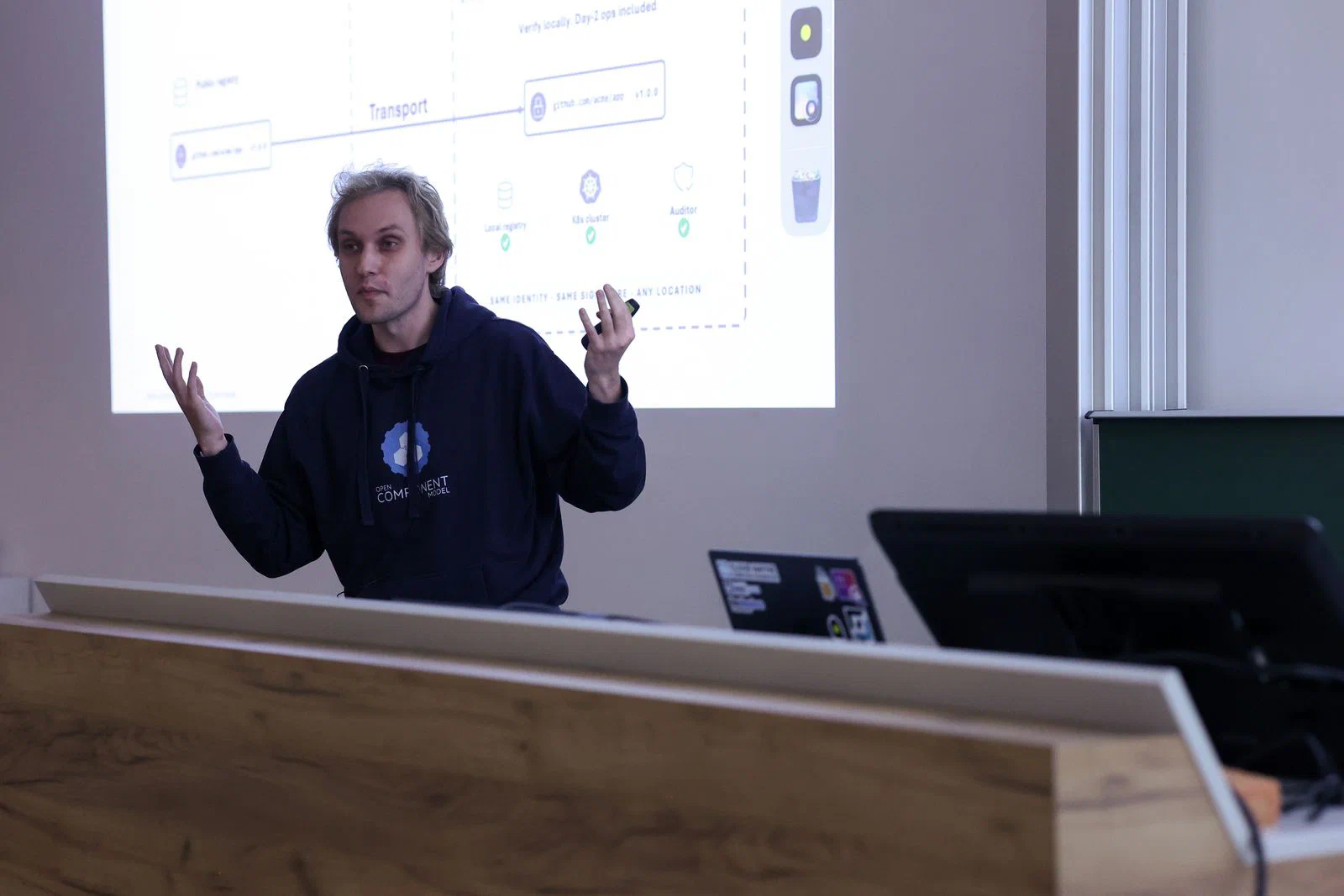
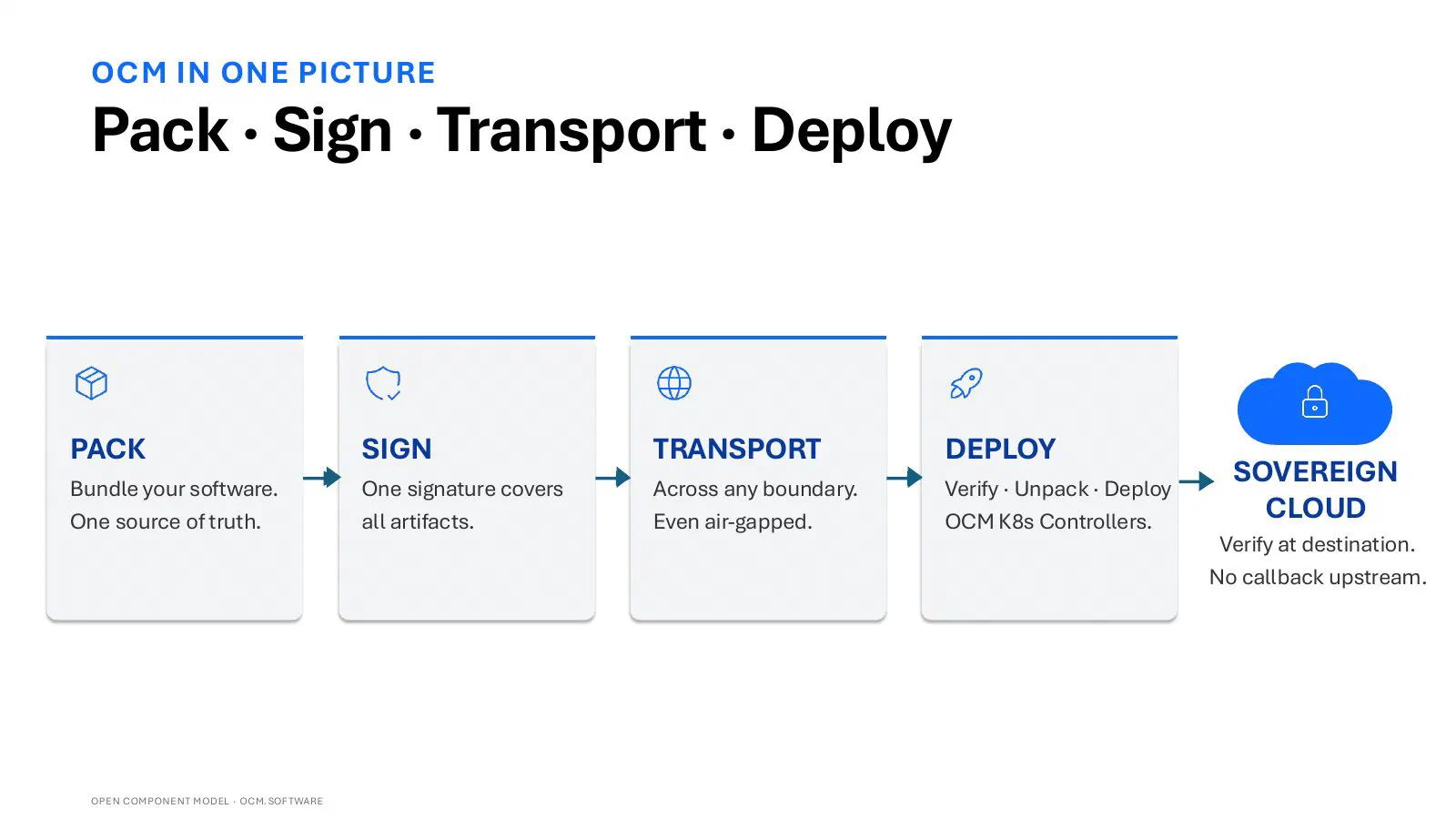
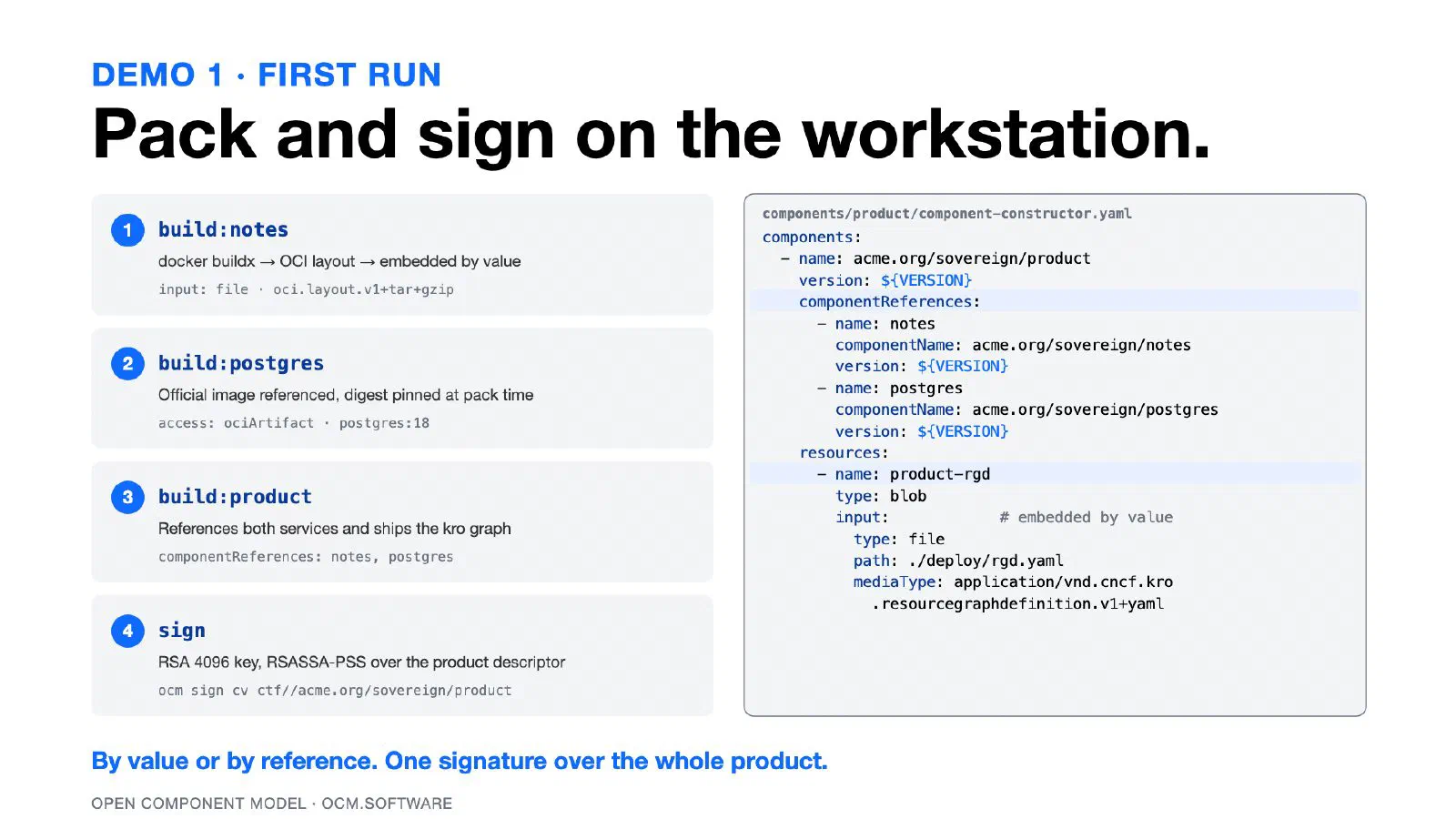
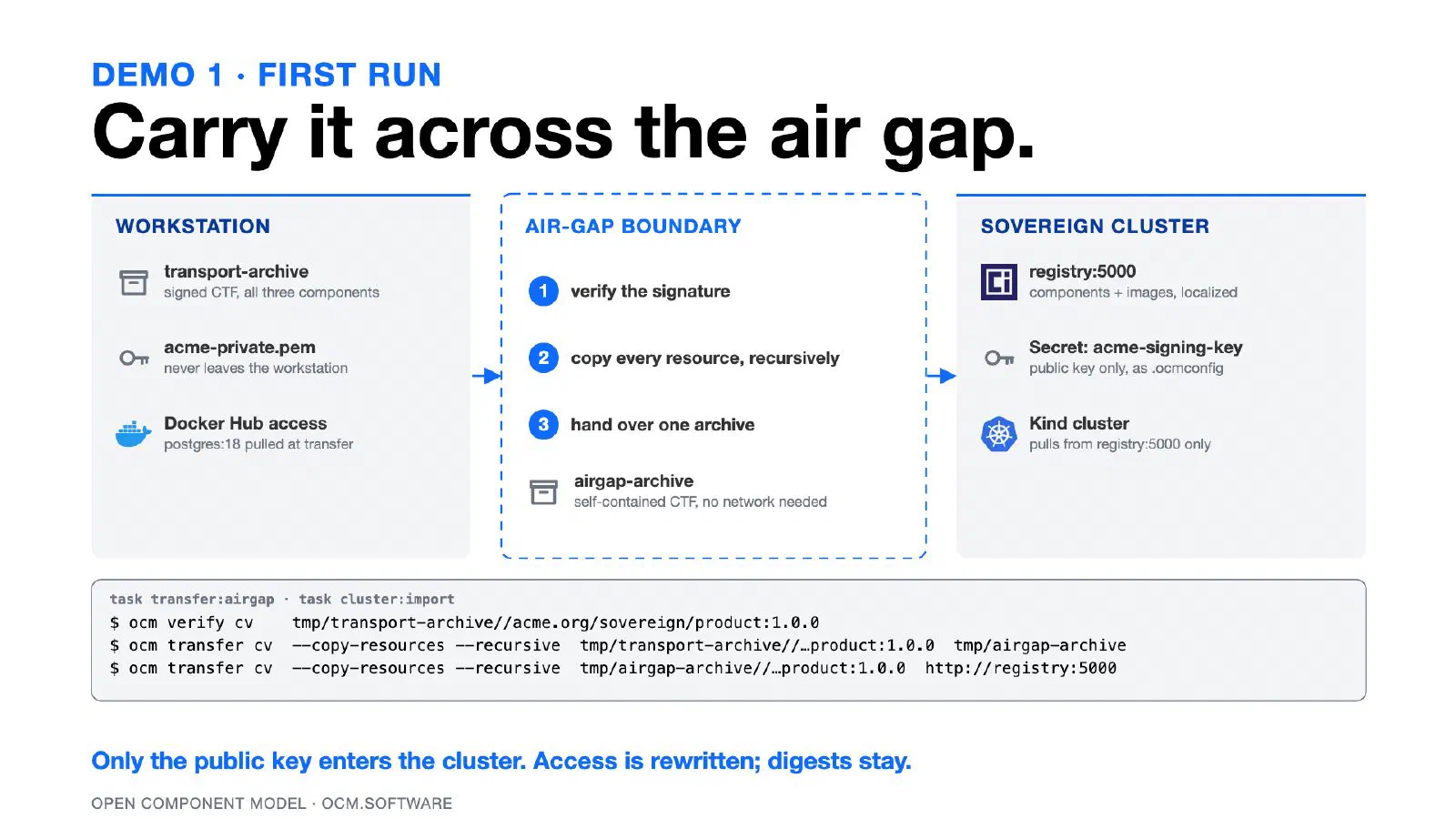
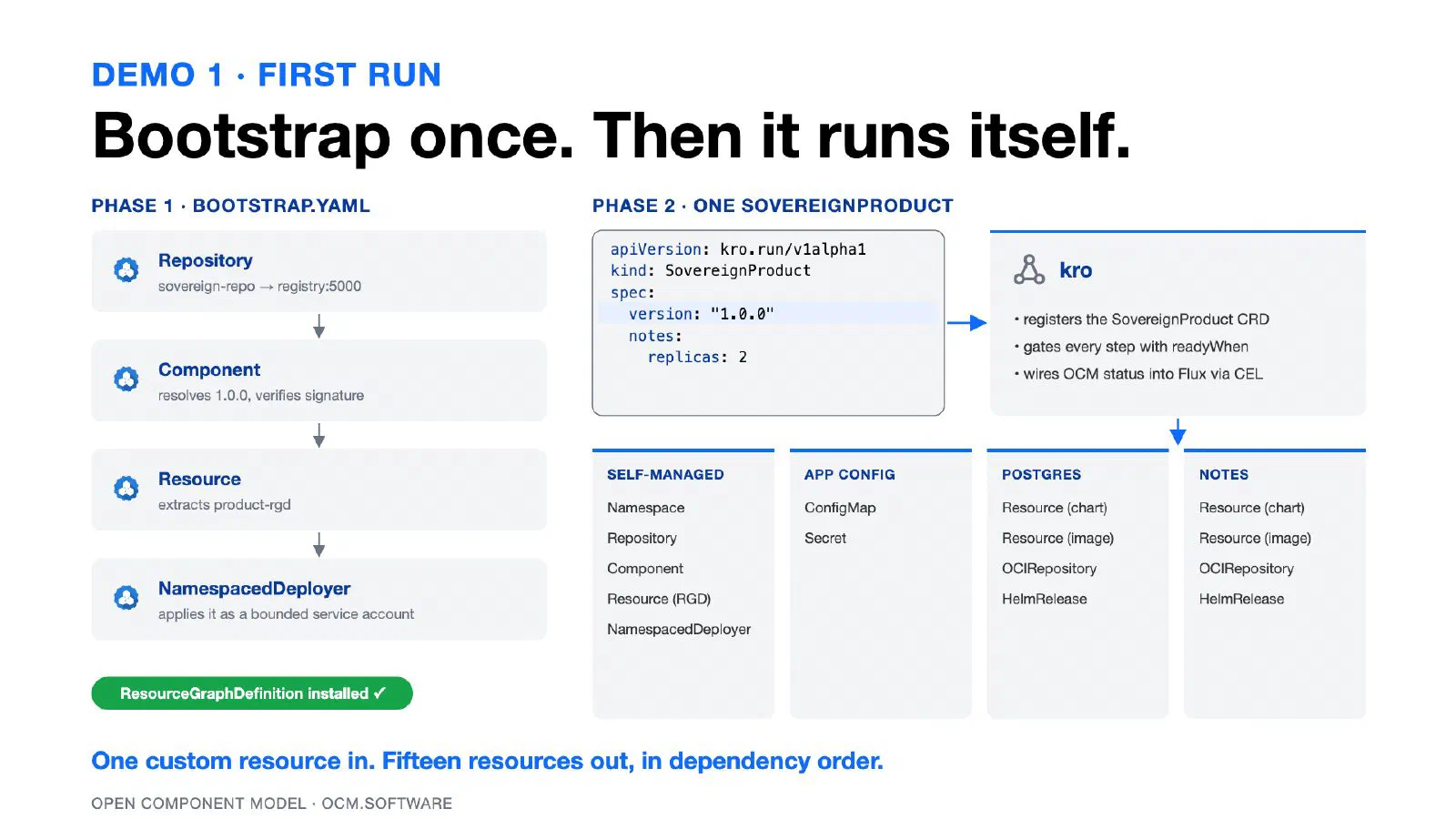
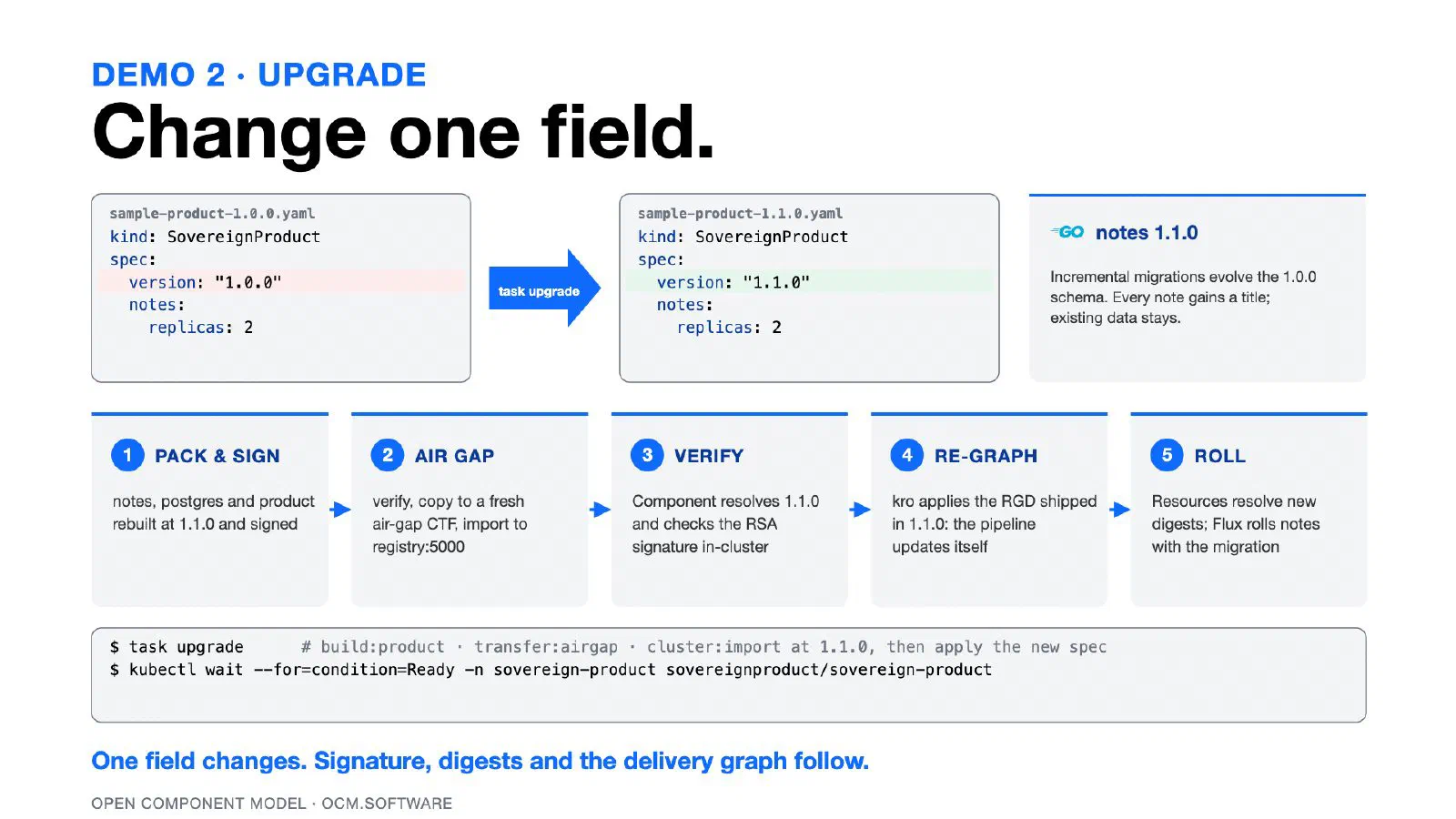
The talk condensed the OCM workflow into four steps:
Same identity, same signature, any location. Operators and auditors inside the sovereign environment verify locally and run Day-2 operations with what was shipped. Nothing has to reach back to the source.
If you want to try this yourself, follow Transfer Components across an Air Gap and Verify Component Signatures on Deployment.
Sovereign delivery is not only a problem for hyperscale platforms. A small team shipping one service into a customer’s private data center faces the same boundary as an enterprise moving hundreds of services into a sovereign region. OCM is designed to scale across that whole range with the same model:
components:
  - name: acme.org/sovereign/product
    version: 1.0.0
    provider:
      name: acme.org
    componentReferences: # no resources of its own, pure composition
      - name: notes
        componentName: acme.org/sovereign/notes
        version: 1.0.0
      - name: postgres
        componentName: acme.org/sovereign/postgres
        version: 1.0.0
Start with a single component for one service. When your landscape grows, compose those components into products, and compose products into platforms, without changing tools or formats along the way. See Add Component References for a hands-on walkthrough.
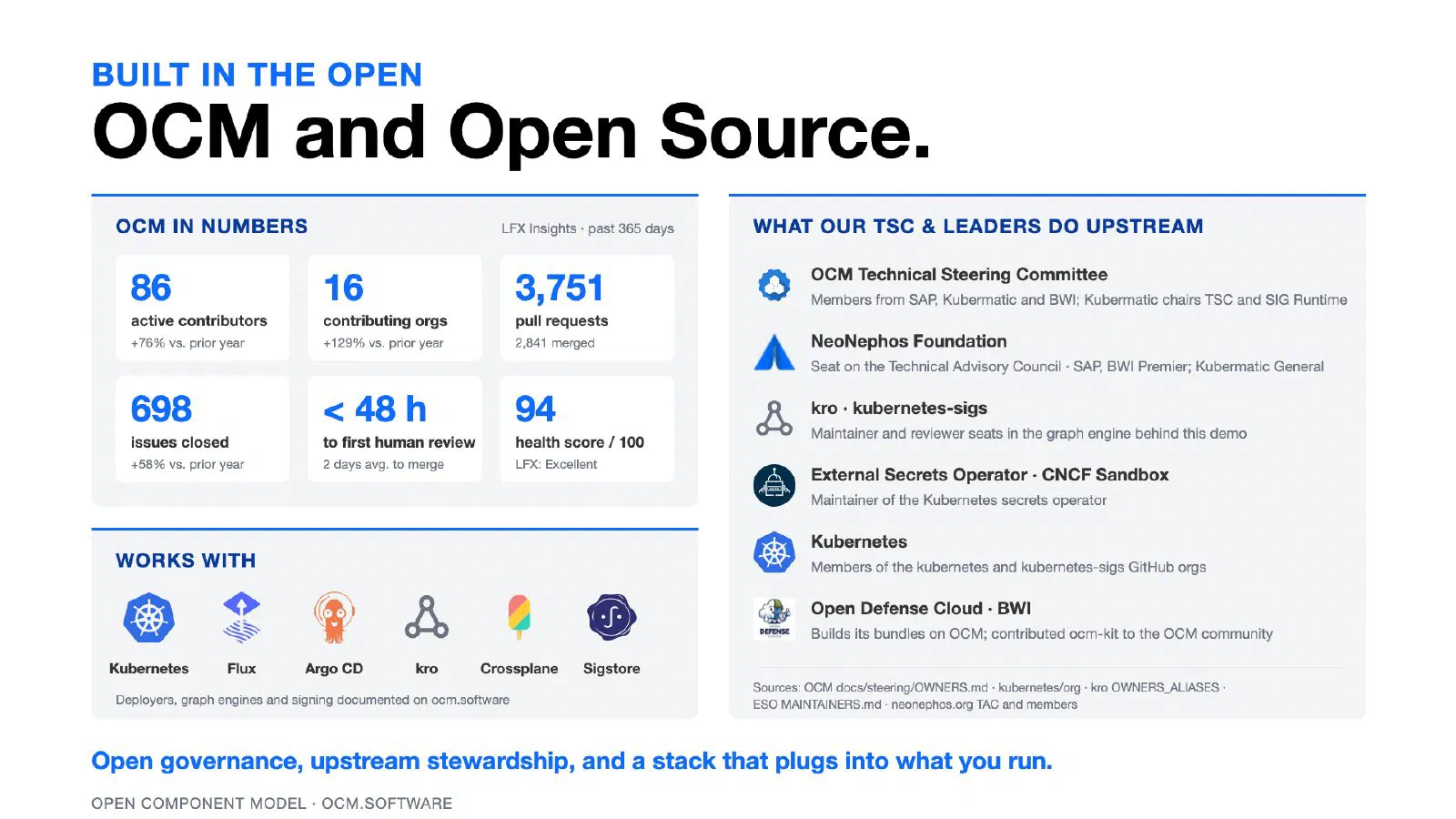
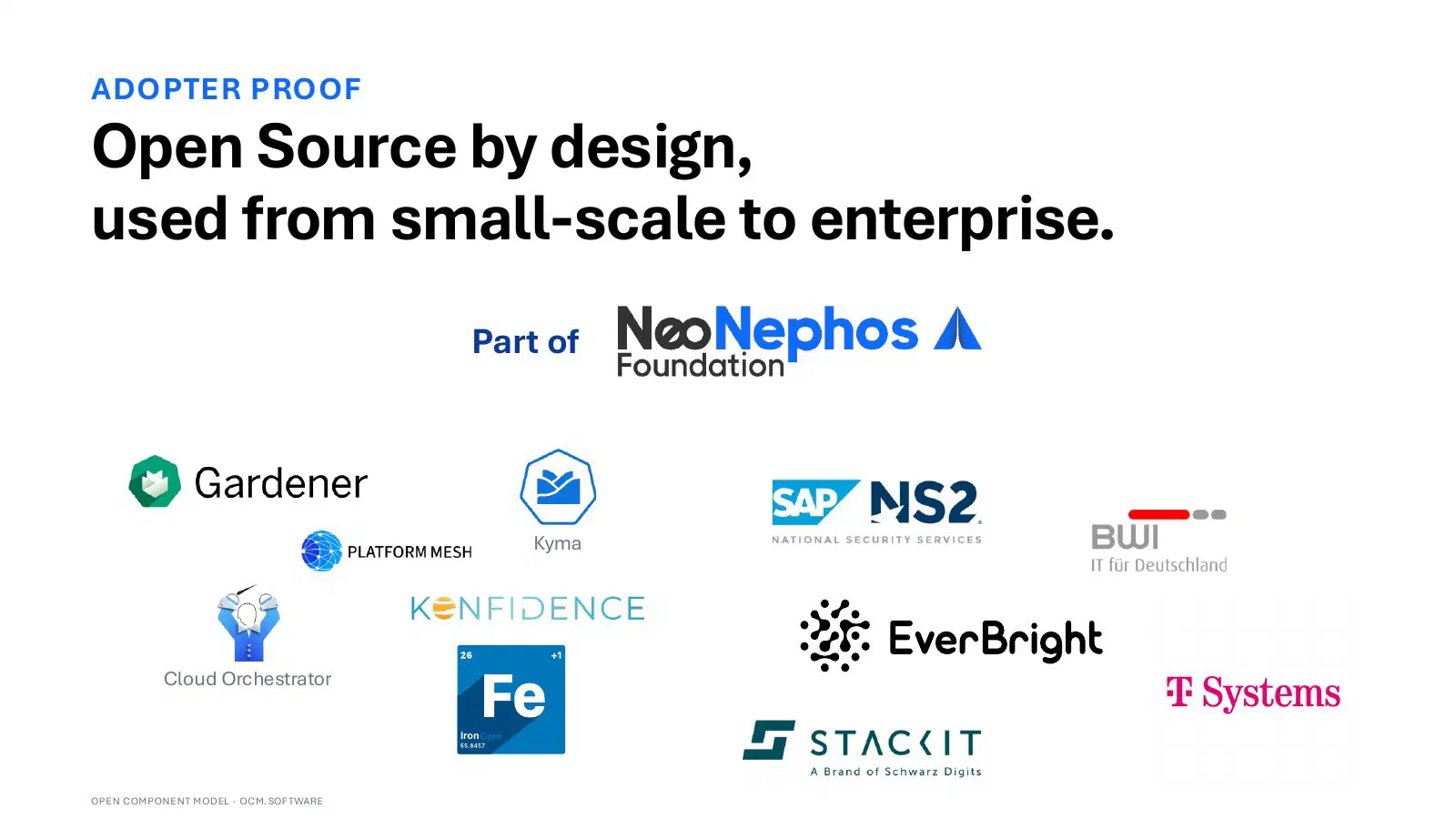
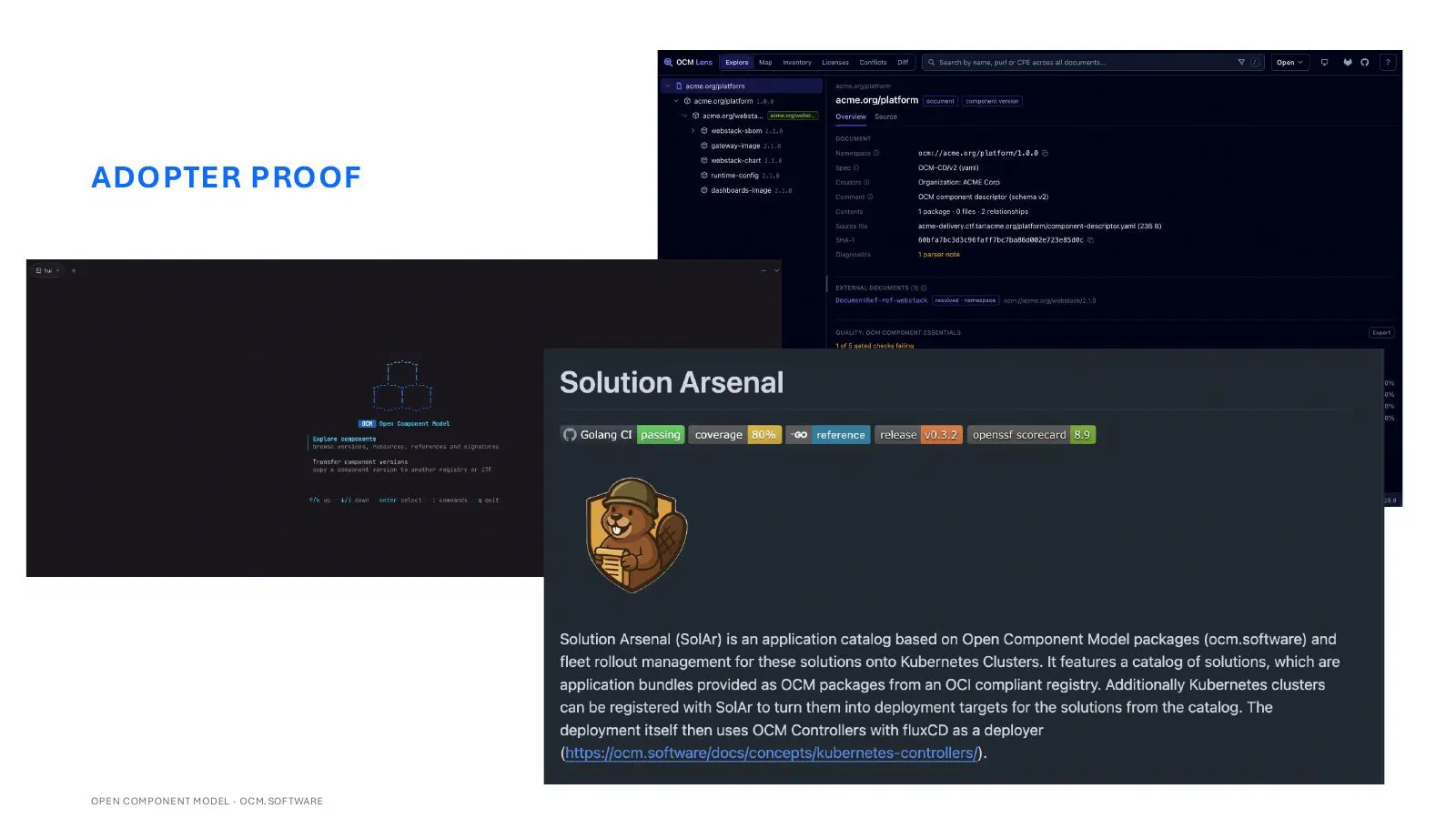
This range is not theoretical. OCM is open source by design, part of the NeoNephos Foundation under the Linux Foundation Europe, and in use from small-scale setups to enterprise landscapes, including Gardener, Kyma, OpenControlPlane, and Konfidence.
The talk closed with a simple adoption path:
The Getting Started guides are the fastest way to the first step, and the community page shows how to reach us.
A big thank you to the organizers, htw saar, and everyone who joined the talk and the hallway conversations afterwards. Sovereignty only works if it is open and practical, and that is exactly what this weekend was about. See you next year!
Photos: Julia Schygulla for Sovereign Cloud Days 2026.